Swing or Sliding Driveway Gate? Let Your Site Decide
Slope, space, wind and snow often decide between a swing and a sliding driveway gate before style does. Here is how to match the gate to your driveway.


In this article
A driveway gate is a big, heavy moving object, and the best style for your home is usually decided by the ground it moves over and the space around it. Swing gates and sliding gates can both look good and both be automated. The difference is in how they use space, how they handle slopes and weather, and what it takes to keep them running. Working through your site first will narrow the choice quickly and save you from a gate that drags, sticks or blocks the driveway.
How each type works
A swing gate hangs on hinges attached to a post or pillar and pivots open like a door. Driveways often use a pair of leaves that meet in the middle, though a single leaf works for narrower openings. Swing gates usually open inward, toward the property.
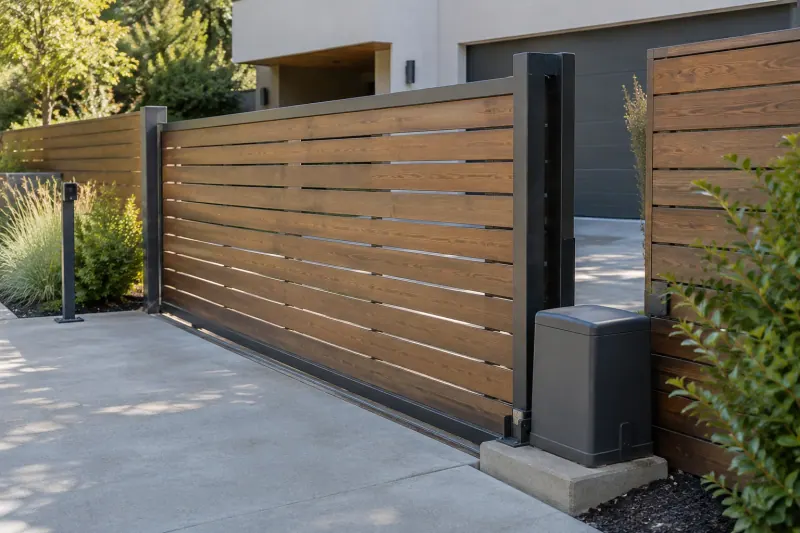
A sliding gate moves sideways along the fence line, parallel to the opening. There are two common designs:
- Track (V-track) sliding gates roll on wheels along a rail set into or onto the driveway.
- Cantilever sliding gates have an extra counterbalance section behind the opening and ride on rollers mounted to posts, so the gate hangs above the ground and never touches the driveway.
Start with your site
Slope
A swing gate needs a fairly level arc to open into. If the driveway rises behind the gate, the leaves will hit the ground partway through their swing. Installers have workarounds, such as hinges that raise the gate as it opens or a gate shaped to the slope, but a steep driveway often rules out a standard inward swing. Opening the gate outward can solve the slope problem, but many areas restrict gates that swing over a sidewalk or street. Check local rules before planning an outward swing.
Sliding gates travel across the opening rather than into the driveway, so a slope running up the driveway is less of an issue. A side-to-side slope across the opening, however, is a challenge for any sliding gate and is something your installer must assess.
Space for the swing arc
Each swing leaf needs clear space equal to its width to open fully. That space has to stay free of parked cars, bins, planters and anything else, or the gate can't open. On a short driveway where cars park close to the gate, a swing gate can be impractical.
Side clearance for sliding
A sliding gate needs a straight, clear run along the fence line roughly equal to the width of the opening. A cantilever gate needs more, because of the counterbalance section. If a house wall, a tree, a slope or a property line sits where the gate would slide, a sliding gate may not fit.
Wind, snow and weather
Wind pushes on a gate like a sail, especially a solid one. A swing gate catches wind across its full face, which strains hinges and operators and can make the gate hard to control. Sliding gates are generally less affected because they move along the line of the fence. If you want a solid privacy gate in a windy spot, ask the installer how they size the operator and posts for wind load, or consider a design with some openness.
Snow and ice affect the types differently. A swing gate needs its whole arc cleared before it can open. A V-track sliding gate needs its track kept clear of snow, ice, gravel and leaves, or the wheels can jump or stall. A cantilever gate, which doesn't touch the ground, is often the most practical choice where snow is regular, as long as the run-back space is clear.
Side-by-side comparison
| Factor | Swing gate | Sliding gate (track) | Sliding gate (cantilever) |
|---|---|---|---|
| Space needed | Clear arc behind the opening | Clear run along fence line | Longer run along fence line |
| Sloped driveway | Difficult for inward swing | Usually workable | Usually workable |
| Wind | Most affected | Less affected | Less affected |
| Snow and debris | Arc must be cleared | Track must be kept clear | No ground track to clear |
| Automation | One operator per leaf | One operator | One operator |
| Ground contact | None, apart from any center stop | Wheels on a track | None |
| Main maintenance points | Hinges, operator arms | Track, wheels, operator | Rollers, operator |
What drives cost
Gate prices vary too widely by region, material and site for a general figure to be useful. These are the main factors that move a quote up or down:
- Width and height of the opening, and whether you need one or two leaves.
- Material and design, such as steel, aluminum or wood, and solid versus open patterns.
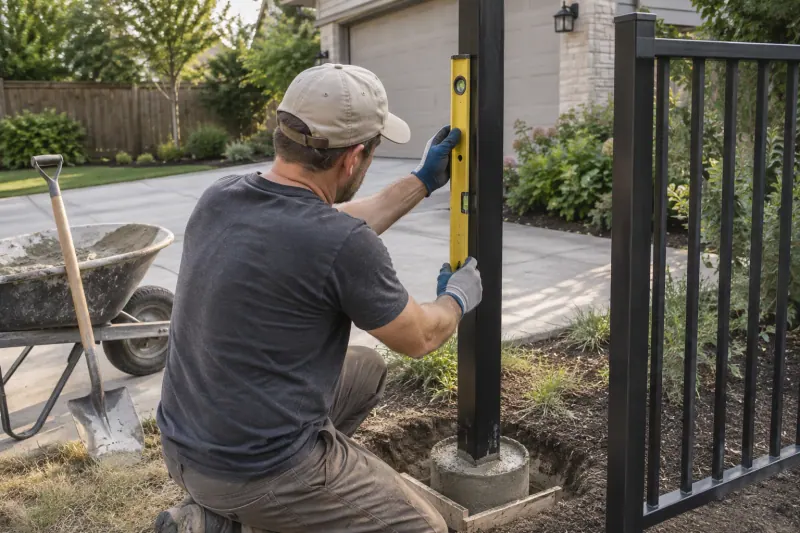
- Foundations and posts. Swing gates need posts that can carry the leaf's weight at the hinge. Cantilever gates need strong posts and a longer frame.
- Site work, such as grading a slope, setting a track or cutting into existing paving.
- Automation, including the operator, the power supply and safety devices.
- Electrical work, especially if power must be trenched a long way from the house.
Automation differences
Automated swing gates typically use an operator for each leaf. Common types include articulated arm operators, linear actuators and operators installed below ground at the hinge. Two leaves must be coordinated so they open and close in the right order.
Automated sliding gates usually use a single operator that drives the gate along a toothed rack or a chain. That simplicity is one reason sliding gates are popular for automated driveways where space allows.
Both types create pinch and entrapment points that must be protected with safety devices such as photo eyes and edge sensors. The zones are different for each design, which our automatic gate safety explainer covers in detail.
Maintenance
Swing gates need their hinges checked and lubricated, and their posts watched for sagging, which shows up as a leaf that drags or won't latch. Operator arms and mounting brackets should stay tight.
Track sliding gates need the track kept clean and straight, and wheels replaced when they wear. Cantilever gates need periodic checks of the rollers and their brackets. For any automated gate, the safety devices should be tested regularly and the operator serviced as its manufacturer recommends.
When to call a pro
Bring in a gate installer once you've measured your site and have a sense of which type fits. A good installer will check slope, soil, wind exposure and power before recommending a design, and will build safety devices into the quote. Our guide to choosing a gate installer lists the questions to ask.